
What Is a Heat Meter and What Is It Used For?
A heat meter is a device used to measure the energy consumed in central heating and cooling systems. Using two sensors it measures the temperature difference between the supply and return lines, and it determines the flow of water through the system with a flow meter.
more efficient tomorrows
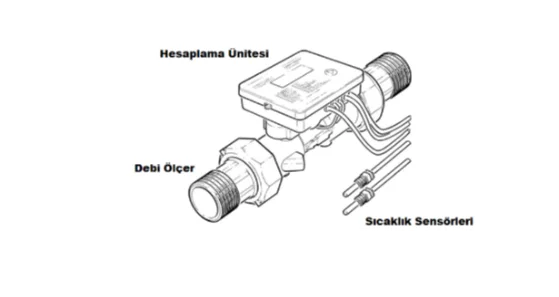
A heat meter (also called a calorimeter or thermal energy meter) is a device used to measure the energy consumed in central heating and cooling systems. It is commonly used in central systems with manifold (apartment-level) distribution. With its two sensors it measures the temperature difference (Δt) between the supply and return lines, and with its flow meter it determines the amount of water passing through the system (m³/h).
Types and use of heat meters
Heat meters use these measured values to calculate the energy consumed (kWh). Thanks to an integrated communication module offering wired or wireless communication, consumption values can be obtained without going to the device. In addition to consumption, energy meters show other measured values (supply temperature, return temperature, flow) on their display, send them to the communication unit and store them in memory.
What is a heat meter?
A heat meter is a measuring instrument used in central heating systems to calculate the energy consumption of each independent unit. It consists of mechanical and electronic components and has a flow measuring system and an electronic calculator.
What is a mechanical heat meter?
A mechanical heat meter works with a turbine (impeller) system that volumetrically measures the amount of water passing through it. Measurement is mechanical, while the calculation is performed by the electronic calculator.
What is an ultrasonic heat meter?
An ultrasonic heat meter measures water flow using ultrasound. It has no moving parts, and measurement and calculation are fully electronic.
What is the difference between mechanical and ultrasonic heat meters?
Although mechanical and ultrasonic heat meters basically perform the same function, their measuring systems differ. Ultrasonic systems are less prone to under-registration than mechanical systems and are more stable.
Use of thermostatic valves
In systems with heat meters or heat cost allocators, thermostatic valves are mandatory and save energy. Thermostatic valves reduce energy consumption by automatically regulating the room temperature.
Saving energy with heat meters
A heat meter system does not save energy on its own. Using thermostatic valves to prevent unnecessary heating is the most effective way to save.