
How Should Thermostatic Valves Be Used?
What is a thermostatic valve and how should it be used?
more efficient tomorrows
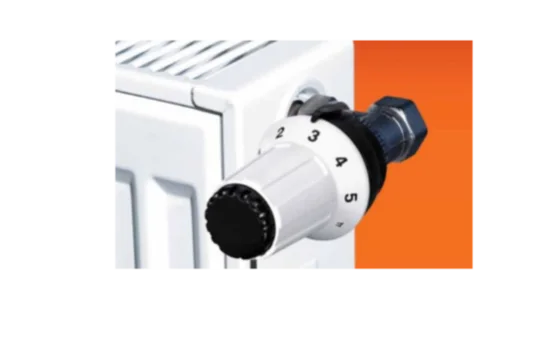
What is a thermostatic valve and how should it be used?
A thermostatic valve is an automatic temperature control device fitted to the radiator inlet. It is an automatic control element that keeps the room at the temperature you want.
Working principle
The liquid sensor in the plastic head expands when the room temperature rises, pushes the valve stem and closes the valve. When the room temperature drops, it contracts, the compressed spring pushes the stem back and the valve opens again.
The numbers on the thermostatic valve indicate temperature values:
| Setting | * | 1 | 2 | 3 | 4 | 5 |
|---|---|---|---|---|---|---|
| Room temperature achieved | 8 °C | 12 °C | 16 °C | 20 °C | 24 °C | 28 °C |
* position: the setting to use when the radiator is not in use.
Thermostatic valves work according to the temperature of the room they are in. As soon as the room reaches the temperature set on the valve, it shuts off the water supply to the radiator; once the temperature drops 0.5 °C below the setting, it lets water into the radiator again until the desired temperature is reached.
If the temperature you set is higher than your room can reach, water will flow into the radiator continuously and your fuel costs may rise. The setting must therefore be chosen carefully. For example, if your room never gets above 24 °C and you set the valve to 25 or higher, the radiator will be supplied continuously because that temperature is never reached — this is completely wrong use. In such cases the valve should be set to at most 24 °C, so that you get the maximum temperature and the valve goes into standby once the desired temperature is reached, saving energy.
Points to note when using thermostatic valves
- Lowering the room temperature by 1 °C saves about 6%.
- Do not change the valve setting if the radiator cools down. A cooler radiator means the room has reached the desired temperature; the top of the radiator may then be warm and the bottom cold.
- Do not block the valve’s contact with the air. If you want to place furniture in front of the valve, leave a gap of at least 15 cm.
- Do not keep turning the valve on and off. Keep your home at a constant temperature so the system stays in standby longer; if you let the home cool down and heat it up again, the valve will run at maximum until that temperature is reached.
Set it and forget it
The thermostat keeps a constant temperature in your room — set your preferred temperature and that’s all. The thermostat opens and closes according to heat demand and therefore makes use of free heat from sunlight, appliances and people.
Extra heat saves energy
Sunlight, kitchen appliances and electric lights give off extra heat. The thermostat detects this and closes automatically; when there is not enough extra heat in the room, it opens again automatically.
Please do not cover the thermostat!
The thermostat must be able to sense the room temperature. If it is covered, for example by a thick curtain or furniture, use a thermostat with a remote sensor.